
How to Learn New Words without Memorising Lists
One of the questions I hear most often from English learners is, „How can I remember more vocabulary?“
For many people, the first idea that comes to mind is making long vocabulary lists. They write down dozens of new words, add translations next to them, read the list a few times, and hope that the words will stay in their memory. Sometimes they do for a day or two. More often, however, most of those words are forgotten surprisingly quickly, leaving learners frustrated and convinced that they simply have a bad memory.
The truth is that the problem is usually not your memory at all. It is the way the words are being learned.
Vocabulary Is Easier to Remember in Context
Our brains are remarkably good at remembering things that have meaning.
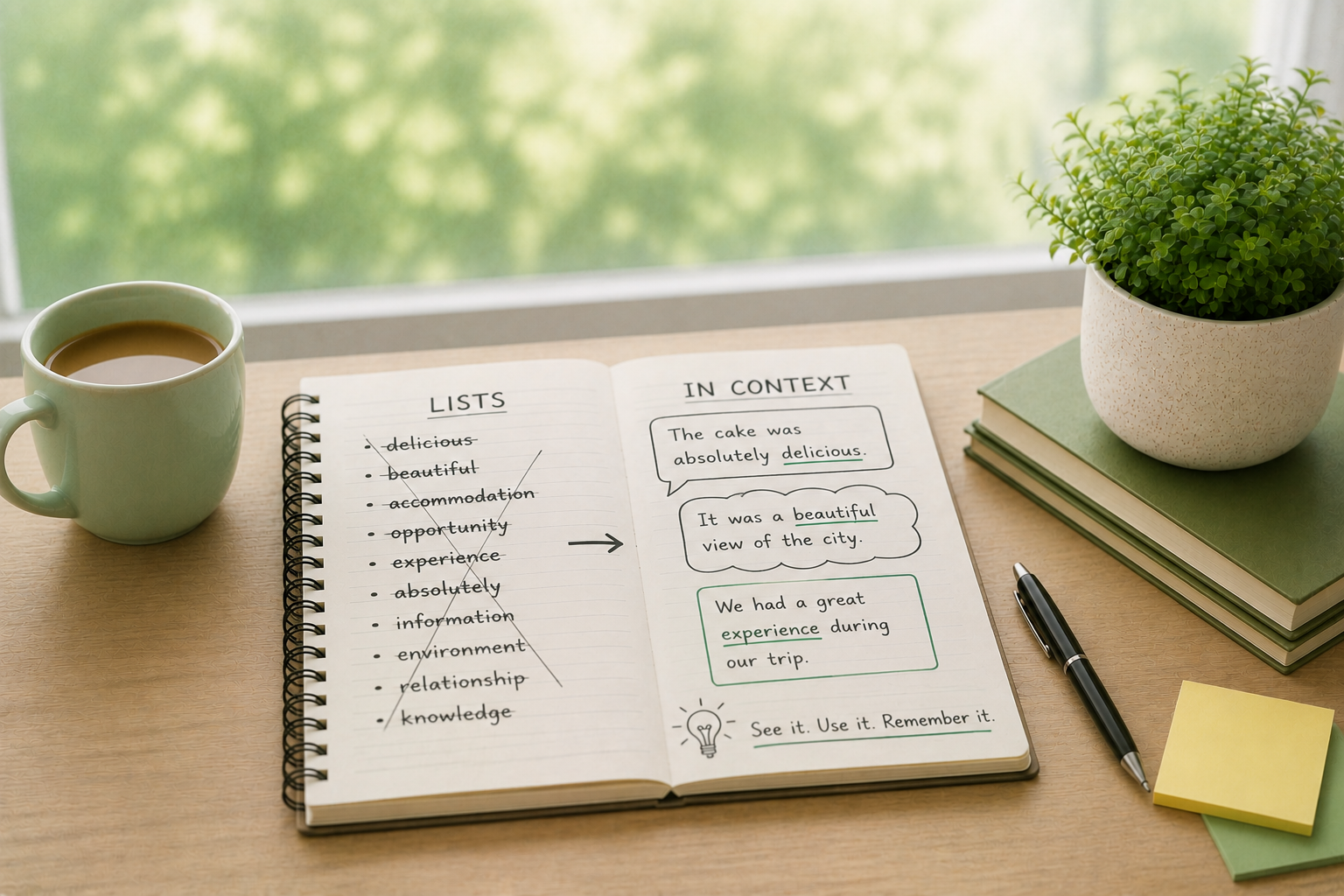
A word written on a piece of paper is just a collection of letters, but that same word becomes much easier to remember when you hear it in a conversation, read it in an interesting story, or use it yourself while talking to someone. The word is no longer isolated; it becomes part of an experience, and experiences are naturally easier to remember than lists.
This is one of the reasons why people often remember expressions from films, songs, or TV series without making any conscious effort. They are not trying to memorize vocabulary. They simply encounter the same words repeatedly in situations that feel meaningful, and little by little those words become familiar.
Instead of learning individual words, try learning them as part of a sentence. For example, rather than writing down the word delicious, write down The cake was absolutely delicious. Better yet, create your own sentence about something that is relevant to your life. The more personal the example is, the easier it becomes for your brain to remember it later.
Focus on Useful Words, Not More Words
Another mistake learners often make is trying to learn vocabulary that they are unlikely to use. It is easy to be attracted to long, impressive words because they make us feel like we are making fast progress, but vocabulary only becomes valuable when it becomes part of our everyday communication.
If you enjoy travelling, focus on words you might actually use at an airport or in a hotel. If you work in an office, learn the language that comes up in meetings or emails. When vocabulary reflects your own life, you naturally encounter it more often, which makes remembering it much easier.
It is also worth remembering that learning fewer words can sometimes produce better results. Trying to memorize thirty new words in one evening may feel productive, but if you never come across them again, most of them will disappear within a few days. Learning five or six useful words and meeting them repeatedly through reading, listening, writing, and speaking is usually a much more effective approach.
Use New Vocabulary as Soon as You Can
One of the fastest ways to make a new word stick is to start using it immediately. The moment you include it in a conversation, write it in a message, or use it in a sentence of your own, it stops feeling like something you are trying to memorize and starts becoming part of your active vocabulary.
Many learners become discouraged when they realize they have forgotten a word they learned only a few days earlier, but forgetting is a completely normal part of the learning process. Most words need to be seen and used several times before they become part of your everyday vocabulary. Every time you come across that word again, your brain strengthens the connection a little more.
Building vocabulary is rarely about remembering everything the first time. It is usually a gradual process of seeing a word, forgetting it, recognizing it again, and eventually reaching the point where it comes to your mind naturally.
Final Thought
Building a strong vocabulary is not about collecting as many words as possible or memorizing endless lists. It is about giving those words a place in your daily life by seeing them in context, hearing them regularly, and finding opportunities to use them yourself.
When you stop treating vocabulary as something to memorize and start treating it as something to experience, learning becomes more natural, less frustrating, and, in the long run, far more effective.
Starling is a modern online school of English created to make language learning clear, friendly, and practical.
PIB: 113355898
MB: 66764397
Copyright © 2025 | Starlingschool | All rights reserved
Starling is a modern online school of English created to make language learning clear, friendly, and practical.
PIB: 113355898
MB: 66764397
Copyright © 2025 | Starlingschool | All rights reserved
Starling is a modern online school of English created to make language learning clear, friendly, and practical.
PIB: 113355898
MB: 66764397
Copyright © 2025 | Starlingschool | All rights reserved