
What to Do When You Freeze in the Middle of a Conversation
You are in the middle of a conversation in English and everything is going well. You understand the other person, you know what you want to say, and then, for no obvious reason, your mind goes completely blank. A word that you have used many times before suddenly disappears, you cannot finish the sentence you started, and the more you try to remember what you wanted to say, the more difficult it becomes.
I see this happen with students all the time, and what usually makes the situation worse is not the forgotten word itself, but the pressure that comes immediately afterwards. You start thinking that you should know the word, that the other person is waiting, or that the silence is becoming uncomfortable. Instead of thinking about what you actually want to say, you are now thinking about the fact that you cannot say it.
The important thing to remember is that forgetting a word or losing your train of thought does not mean that your English has suddenly disappeared. Sometimes your brain simply needs a little more time to find what you are looking for, and learning how to deal with those few seconds can make conversations much easier.
Stop Looking for the Perfect Word
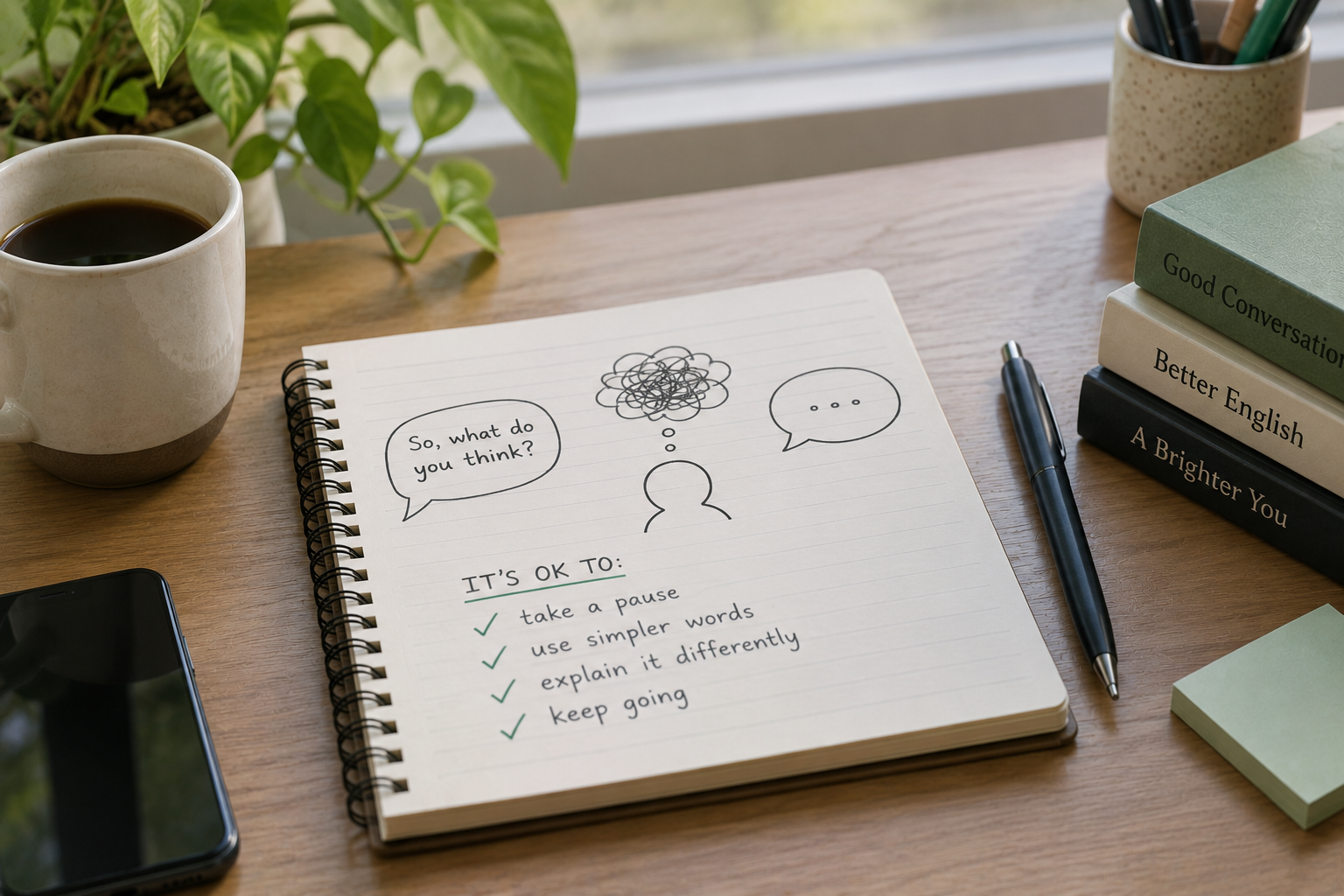
You are in the middle of a conversation in English and everything is going well. You understand the other person, you know what you want to say, and then, for no obvious reason, your mind goes completely blank. A word that you have used many times before suddenly disappears, you cannot finish the sentence you started, and the more you try to remember what you wanted to say, the more difficult it becomes.
I see this happen with students all the time, and what usually makes the situation worse is not the forgotten word itself, but the pressure that comes immediately afterwards. You start thinking that you should know the word, that the other person is waiting, or that the silence is becoming uncomfortable. Instead of thinking about what you actually want to say, you are now thinking about the fact that you cannot say it.
The important thing to remember is that forgetting a word or losing your train of thought does not mean that your English has suddenly disappeared. Sometimes your brain simply needs a little more time to find what you are looking for, and learning how to deal with those few seconds can make conversations much easier.
Stop Looking for the Perfect Word
When a word disappears in the middle of a conversation, our first instinct is usually to search for it. We know that we know it, so we keep trying to find it, while the conversation slowly comes to a stop.
Sometimes it is much easier to let the word go and find another way to explain the same thing. If you cannot remember the word receipt, for example, you can simply say, the paper they give you after you pay. It may not be exactly what you wanted to say, but it communicates the idea, and that is what matters.
This is something we do in our own language as well, probably without even noticing it. We forget names, change sentences halfway through, replace one word with another, or explain something when the exact expression does not come to mind. We do not normally see this as a problem because we trust ourselves to find another way to continue. Learning to do the same thing in English takes some of the pressure away from speaking.
A Pause Is Not as Awkward as It Feels
For many learners, even a few seconds of silence can feel much longer than they really are. There is a feeling that you need to answer immediately, and if you do not, the other person will notice that you are struggling with English.
But real conversations are full of pauses. People stop to think, look for the right word, change their minds, and start sentences again all the time. You are allowed to do that in English too.
If you need a little time, expressions such as Let me think for a second, How can I explain this? or What I’m trying to say is… can help you stay in the conversation while you organise your thoughts. They are not tricks for hiding the fact that you need time. They are simply normal parts of spoken language.
And very often, the pause that feels painfully long to you is barely noticeable to the person you are talking to.
Learn to Recover Instead of Trying to Be Perfect
Speaking confidently does not mean that every conversation goes smoothly from beginning to end. There will always be moments when you forget a word, misunderstand something, or begin a sentence and realise halfway through that you have no idea how to finish it.
What changes with experience is the way you react to those moments. Instead of panicking, you start again. You make the sentence simpler. You describe the word you cannot remember. You ask the other person to repeat something. Then the conversation continues.
This is one of the reasons why real speaking practice matters so much. You cannot prepare every sentence you will ever need, and you cannot predict what another person is going to say. What you can learn is how to stay comfortable when the conversation does not go exactly as planned.
After a while, those moments stop feeling like failures. They simply become part of speaking another language.
Final Thought
The next time your mind goes blank in the middle of a conversation, try not to treat it as a sign that your English is not good enough. Give yourself a few seconds, make the sentence simpler, or explain the idea in another way.
You do not need to speak without pauses, mistakes, or forgotten words in order to have a good conversation. What matters much more is knowing that when you get stuck, you can find your way back and keep going.
Starling is a modern online school of English created to make language learning clear, friendly, and practical.
PIB: 113355898
MB: 66764397
Copyright © 2025 | Starlingschool | All rights reserved
Starling is a modern online school of English created to make language learning clear, friendly, and practical.
PIB: 113355898
MB: 66764397
Copyright © 2025 | Starlingschool | All rights reserved
Starling is a modern online school of English created to make language learning clear, friendly, and practical.
PIB: 113355898
MB: 66764397
Copyright © 2025 | Starlingschool | All rights reserved